


1. Introduction
2. Theory of Acoustic Black Hole
3. Finite element analysis for Acoustic Black Hole
3.1 Tapered Acoustic Black Hole
3.2 Dynamic Absorber-based Acoustic Black Hole
4. Conclusions
1. Introduction
Many researchers have conducted studies to enhance the structural robustness of mechanical systems and to improve their noise and vibration characteristics (Park, 2006). In particular, extensive research has focused on damping and vibration control systems. More recently, studies related to metastructures and acoustic black holes (ABH) have gained significant attention (Hook et al., 2019; Krylov, 2017; Krylov and Tilman, 2004; Mironov, 1988).
This study first reviews the existing theoretical studies on ABH. Subsequently, we analyze ABH structures using elasticity theory and the finite element method, reinterpreting systems that were previously studied based on beam theory. In addition, this study addresses the limitations of conventional theories that assume infinitely large structures.
2. Theory of Acoustic Black Hole
Many studies analyzing Acoustic Black Holes (ABH) have employed the Euler-Bernoulli beam theory due to its simplicity and intuitive nature (Krylov, 2017). Analyses based on this theory offer advantages such as fast computation and ease of physical interpretation. In particular, when describing ABH structures using one-dimensional elastic wave theory, the Euler-Bernoulli approach effectively captures the key bending wave (transverse wave) velocity, making the physical interpretation of the results highly intuitive. However, despite these advantages, this approach has inherent limitations.
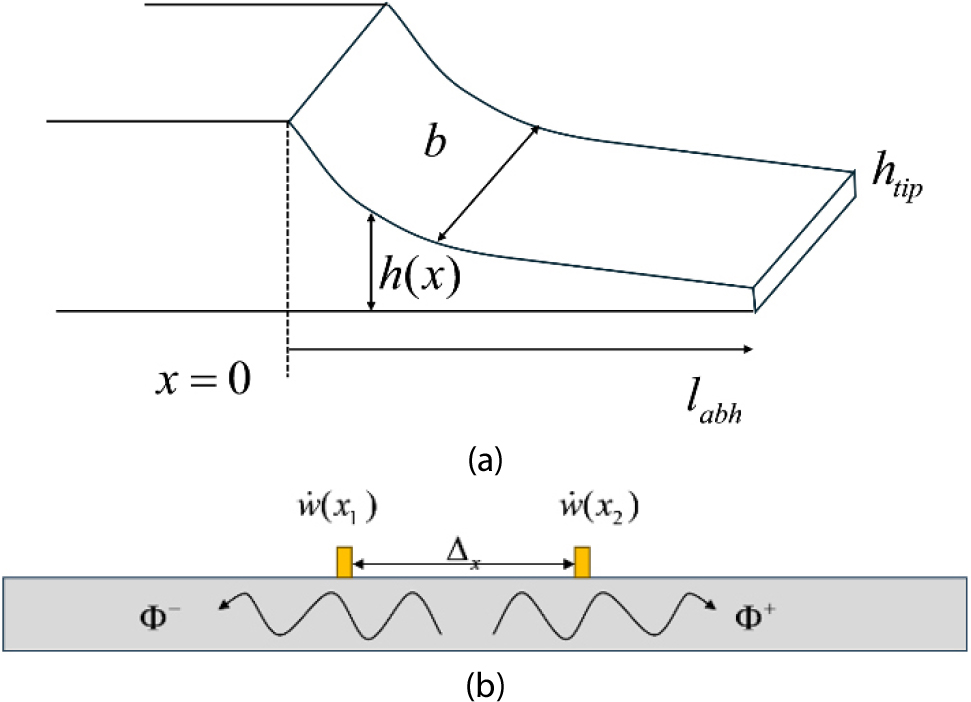
This study aims to identify phenomena that cannot be observed through one-dimensional structural analysis. For this purpose, a two-dimensional finite element method is applied. Fig. 1 illustrates a typical ABH structure with a tapered section. This section exhibits a continuously decreasing thickness.
From the one-dimensional beam theory, the velocity of the transverse wave is given as follows:
In Eq. (1) the density, elastic modulus, and thickness of the Acoustic Black Hole (ABH) structure are denoted by ρs, E, and h(x), respectively. Previous studies have typically implemented ABH structures by gradually reducing the thickness toward zero. More recent studies have also explored alternative implementations by modifying the effective material properties, such as decreasing the effective modulus using lattice structures. A distinctive feature of the ABH structure, as illustrated in Fig. 1, is that as the thickness h decreases toward zero, the transverse wave velocity cf theoretically approaches zero. Consequently, the forward-propagating transverse wave gradually stagnates, and no reflected wave occurs. This phenomenon resembles a black hole in astrophysics, which gives rise to the term Acoustic Black Hole.
To minimize reflections within the tapered section, the thickness h follows a smooth taper profile (e.g., a power-law taper) toward the tip. Although the theoretical tip thickness is zero, this is practically impossible; therefore, a finite thickness is used. Additionally, damping material is applied at the tip to further reduce reflections. Afterward, the transverse wave velocity in the y-direction is measured at two points along the longitudinal direction of the beam separated by a distance Δx, and the reflection coefficient is calculated in Eq. (2), Eq. (3), Eq. (4), and Eq. (5). The general expression for the transverse velocity is given below:
where the angular frequency is denoted by 𝜔. The waves propagating toward the left and right directions are denoted by and , respectively. The wave number is denoted by kf. From the one-dimensional linear elasticity theory, the terms appearing in the above formulation are computed as follows:
The reflection coefficient is defined as:
3. Finite element analysis for Acoustic Black Hole
3.1 Tapered Acoustic Black Hole
As mentioned earlier, this study employs a two-dimensional finite element method to analyze the vibration characteristics of a beam with an acoustic black hole, which cannot be captured by one-dimensional beam theory. To achieve this, the ABH structure was configured as shown in Fig. 2. For two-dimensional elastic wave modeling, the frequency response function (FRF) of a plane strain model was computed. Following previous studies, isotropic damping was applied over the entire beam to realize the ABH effect within a finite beam length. The beam dimensions and material properties were modeled based on values reported in previous research.
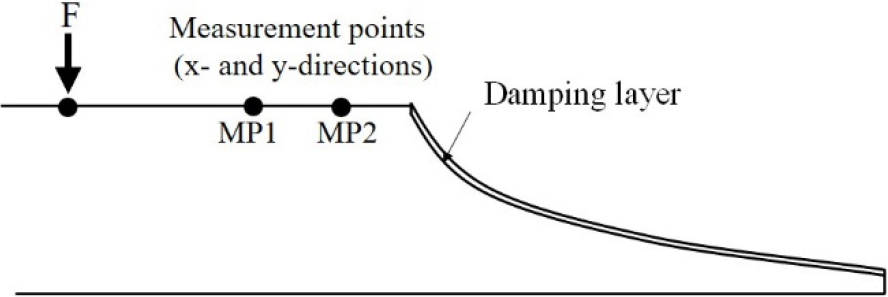
To evaluate the performance and characteristics of the ABH structure, the vibration velocities in both the x- and y-directions were measured at two points located to the right of the excitation point while varying the excitation frequency. The beam length was kept constant throughout the analysis. Based on the one-dimensional wave equation theory described in Section 2, the reflection coefficient was calculated. Fig. 3 shows the reflection coefficient plotted for frequencies ranging from 1Hz to 10kHz at 100Hz intervals while varying the tip thickness of the tapered section with a power-law profile applied along the beam. A lower reflection coefficient indicates better ABH performance.
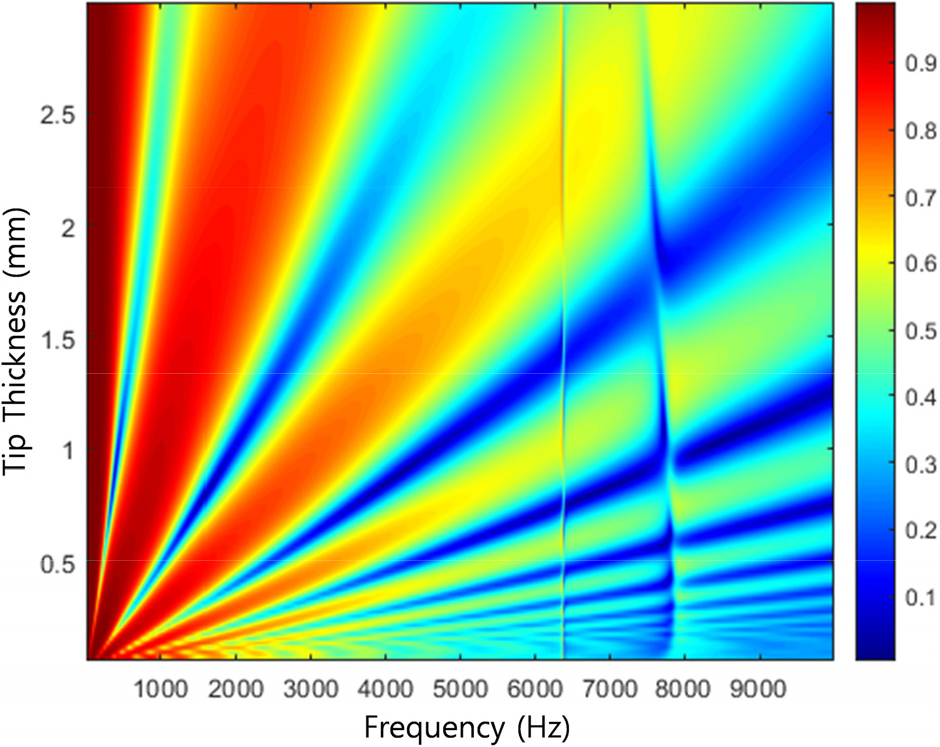
From these results, several observations can be made: First, for a finite beam with a fixed length, the absolute reflection coefficient remains close to unity at low frequencies even as the tip thickness decreases, indicating that the ABH effect does not manifest in this frequency range. This behavior is attributed to impedance mismatch at the beginning of the taper, which causes wave reflections. Although the power-law taper applied along the beam helps reduce this mismatch, the results highlight the practical difficulty of fully satisfying the theoretical conditions described by Eq. (1).
Second, when the tip thickness is reduced, regions of low reflection coefficient exhibit a ripple pattern, which can be clearly observed in Fig. 3. Eigenvalue analysis indicates that these ripples correspond to the natural frequencies of the structure. For example, ripple minima appear around several characteristic frequencies (e.g., approximately 6kHz). Furthermore, as the tip thickness decreases, these ripple patterns tend to shift toward lower frequencies. According to Eq. (1) and Euler-Bernoulli beam theory, this occurs because the natural frequencies of the tapered structure decrease as the tip becomes thinner, and the spacing between adjacent natural frequencies becomes smaller. This behavior is consistent with the operating principle of dynamic vibration absorbers.
Third, in real finite structures, the reduction of reflected waves is influenced not only by the dynamic absorber effect associated with Eq. (1) but also by the combined effects of structural properties, damping, and geometric dimensions. Additionally, unlike the one-dimensional beam theory, the two-dimensional finite element analysis reveals additional phenomena. For example, reductions in the reflection coefficient appear around 6,300Hz and 7,800Hz due to vibration modes in the transverse (y) direction. These modes do not appear in the one-dimensional model and therefore represent behaviors that occur only in real finite structures.
3.2 Dynamic Absorber-based Acoustic Black Hole
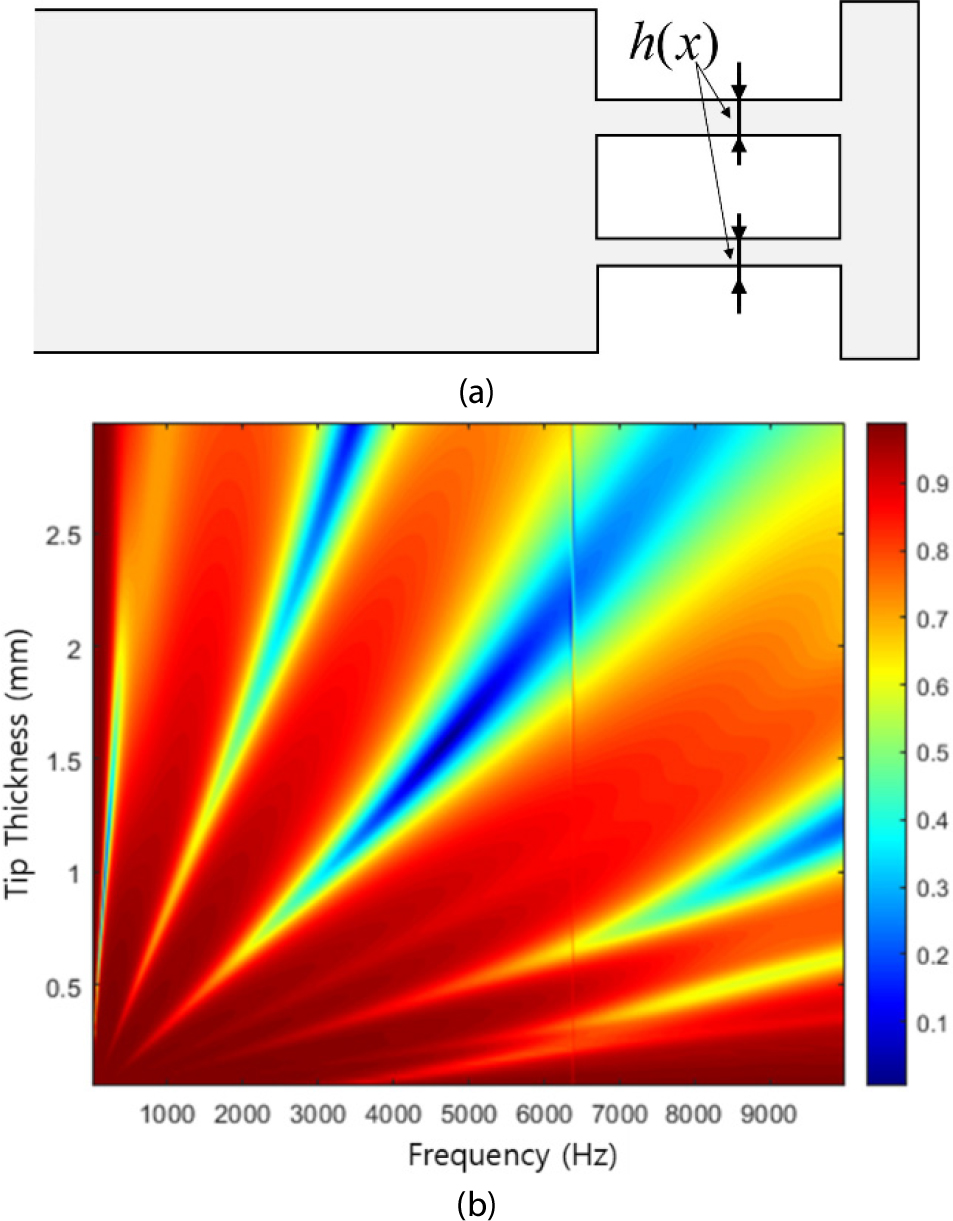
The preceding simulations indicate that the ABH performance is significantly influenced by the local resonances of the tapered region and the damping material. This suggests that other types of structures with transverse eigenmodes may also be effective for ABH-inspired wave attenuation. To investigate this, the tip mass with a slender beam structure in Fig. 4(a) is analyzed using the same material properties as those in the ABH of Fig. 2. Fig. 4(b) shows the absolute reflection coefficient as a function of frequency and thickness. Compared with the ABH, a similar level of absorption can be obtained. However, as the tip thickness decreases, the impedance mismatch between the main beam and the slender horizontal beams becomes significant, causing a deterioration of the dynamic vibration absorber, resulting in higher reflection coefficients.
4. Conclusions
The concept of an Acoustic Black Hole (ABH) is based on the principle that, as the thickness of a slender beam-like structure approaches zero, the propagation speed of flexural waves decreases along the tapered region, theoretically suppressing wave reflection. Previous studies have primarily relied on one-dimensional beam theory assuming an infinitely long beam and later extended the analysis to two- or three-dimensional models. In this study, the theoretical foundations of ABH were revisited, and the structural behavior of ABH systems was investigated using the finite element method (FEM) while considering finite beam length and structural damping. The main findings of this study can be summarized as follows:
1) It was reaffirmed that an infinitely long structure cannot be realized in practice. Therefore, for a finite beam, the transverse wave speed cannot physically reach the zero-velocity limit, making the ideal theoretical condition unattainable in practical structures.
2) The two-dimensional analysis revealed that the dominant mechanism responsible for the reduction of reflected waves is not solely the decrease of transverse wave speed predicted by ideal theory. Instead, the behavior is similar to that of metastructures, where resonance effects in the tapered section act as a dynamic vibration absorber.
3) Compared with conventional dynamic absorbers and metastructures, the smooth thickness tapering of ABH structures results in relatively lower reflection levels than other absorber geometries.
4) Consistent with previous studies, damping plays a crucial role in ABH performance. The present results indicate that the observed attenuation arises from the combined influence of resonance and damping rather than from the idealized zero-reflection condition described in theory. In particular, localized damping near the tapered tip may enhance energy dissipation and can approximate the infinite-length condition assumed in theoretical ABH models. However, the resulting behavior may depend on the distribution of damping.
The term “acoustic” generally refers to phenomena related to airborne sound generation, transmission, absorption, and reflection. However, many studies on ABH are fundamentally based on theories of structural flexural wave vibrations in solid structures rather than airborne sound. Therefore, revisiting and refining the terminology used in ABH research is desirable. Such clarification could lead to a deeper understanding of the underlying mechanisms and provide clearer insights into the industrial applicability and limitations of ABH structures.