


1. Introduction
2. Methodology
2.1 Problem definition
2.2 PINN approximation of membrane deflection
2.3 Physics residual inside the membrane domain
2.4 Edge moment enforcement
2.5 Loss function and training strategy
3. Results and Discussion
4. Conclusion
1. Introduction
Biological membranes are thin, deformable interfaces that define cellular boundaries and regulate the exchange of matter between the intracellular and extracellular environments. Structurally, lipid membranes are commonly represented as bilayers composed of phospholipid molecules, which form a flexible two-dimensional surface embedded in three-dimensional space. Their mechanical response plays an important role in several cellular processes, including membrane remodeling, vesicle formation, endocytosis, exocytosis, and signal transduction. Because many of these functions are strongly influenced by curvature and bending deformation, accurate modeling of lipid membrane mechanics is essential for understanding both biological behavior and the design of membrane-inspired soft material systems (Lipowsky, 1995).
Several computational approaches have been developed to investigate membrane morphology at different length and time scales. Molecular dynamics simulations provide atomistic-level information on lipid interactions and local membrane organization, while coarse-grained models enable the study of larger membrane systems over longer time periods. Although these methods have contributed significantly to the understanding of lipid bilayer behavior, they often require substantial computational resources, especially when large-scale deformation or long-duration membrane evolution is considered. Continuum-based formulations, therefore, remain valuable because they describe membrane deformation using energy principles and governing differential equations. Among these, the Helfrich model is widely used to represent the bending energy of lipid membranes in terms of curvature-dependent quantities (Campelo et al., 2014).
In continuum membrane mechanics, the equilibrium shape of a lipid bilayer is commonly obtained from the minimization of curvature-based elastic energy. However, the resulting governing equations are often nonlinear and involve high-order spatial derivatives. For simplified geometries and boundary conditions, analytical solutions may be available, but such solutions are generally limited to idealized cases. Conventional numerical methods, such as finite difference and finite element methods, can solve these equations, but they require mesh generation, careful treatment of boundary conditions, and sufficient numerical resolution to capture smooth curvature fields (Yoo and Kim, 2016; Lee et al., 2023). These requirements become more challenging when the governing equation is of higher order or when the physical constraints are imposed through moment or force boundary conditions (Liu et al., 2025; Wang et al., 2025).
Physics-informed neural networks have recently emerged as a promising approach for solving differential equations by embedding physical laws directly into the training process. Unlike purely data-driven neural networks, PINNs do not necessarily require labeled solution data. Instead, they minimize residuals associated with the governing equation and boundary conditions at collocation points distributed across the computational domain. This makes PINNs attractive for mechanics problems where experimental data are limited, but reliable governing equations are available. Previous studies have demonstrated the potential of PINNs in structural bending, shell mechanics, membrane form-finding, nano-beam analysis, and other high-order PDE problems. However, their application to lipid membrane bending under edge-applied moment conditions remains relatively limited (Kim and Lee, 2024; Wei et al., 2026).
This study focuses on the moment-induced bending behavior of a rectangular lipid membrane using a simple physics-informed neural network formulation. The membrane is modeled using the linearized Helfrich shape equation under prescribed edge moments, following the analytical framework available for rectangular membrane domains. In contrast to more complex adaptive PINN strategies, the present work adopts a fixed-weight PINN formulation to provide a simpler and more reproducible computational framework. The neural network approximates the transverse membrane deflection, while the governing fourth-order PDE and edge moment boundary condition are enforced through the loss function. A boundary-constrained trial function is used to satisfy the zero-deflection condition along the membrane edges, and automatic differentiation is employed to compute the required higher-order derivatives.
The main contribution of this work is to demonstrate that a simple PINN can accurately reproduce the analytical moment-driven deformation response of a rectangular lipid membrane without using labeled training data. The predicted deflection fields are compared with analytical solutions for different applied edge moments, and the model performance is evaluated using maximum deflection, cross-sectional deformation profiles, and error metrics. Through this focused study, the proposed framework provides a mesh-free and physically consistent approach for solving high-order membrane mechanics problems governed by curvature-dependent deformation.
2. Methodology
2.1 Problem definition
This study considers the bending deformation of a rectangular lipid membrane subjected only to prescribed edge moments. The membrane is treated as a thin elastic surface whose transverse displacement is represented by w(x,y). The deformation is governed by the linearized form of the Helfrich membrane equation, which relates the bending stiffness, surface tension, and out-of-plane displacement of the bilayer. For the moment-driven case, the governing equation can be written in the general form as Eq. (1)
where D is the membrane bending modulus, σ is the surface tension parameter, and w is the transverse deflection. The rectangular membrane domain is defined as Eq (2)
where 2a and 2b are the membrane length and width, respectively. The membrane edges are assumed to satisfy a zero-displacement condition, while the bending response is controlled by the applied edge moment. The analytical solution reported by (Belay et al., 2016) is used only as a reference for validation after training and is not used as training data.
2.2 PINN approximation of membrane deflection
The membrane deflection field is approximated using a physics-informed neural network. The spatial coordinates and applied moment are used as input variables, while the network output represents the predicted transverse displacement field. To improve the satisfaction of the essential boundary condition, the network prediction is expressed through a boundary-constrained form Eq (3),
Where denotes the neural network approximation and is a boundary envelope function that becomes zero along the outer edges of the rectangular domain. This formulation ensures that the predicted displacement satisfies on 𝜕𝛺 without requiring an additional penalty term for the zero-displacement condition. Therefore, the learning process mainly focuses on satisfying the governing equation inside the domain and the moment-related condition along the membrane boundary.
2.3 Physics residual inside the membrane domain
The first part of the training objective enforces the governing membrane equation at collocation points distributed inside the rectangular domain. The physics residual is defined as Eq (4)
where the required spatial derivatives are computed using automatic differentiation. The interior equilibrium loss is then calculated as the mean squared residual over the sampled interior points Eq (5):
where is the number of collocation points inside the membrane domain. In this study, 18,000 interior collocation points were used to evaluate the governing equation residual.
2.4 Edge moment enforcement
The second part of the loss function enforces the bending moment condition along the membrane boundary. For a rectangular membrane subjected to prescribed edge moments, the moment condition is related to the curvature of the predicted deflection field. Therefore, the boundary residual is expressed in a general form as Eq (6)
where M is the applied edge moment. The corresponding boundary loss is written as Eq (7)
where is the total number of boundary collocation points. In this work, 3,200 boundary points were used, with an equal number of points sampled along each edge of the rectangular membrane. This sampling strategy allows the applied moment condition to be enforced consistently along the complete boundary.
2.5 Loss function and training strategy
The total training objective was constructed by combining the interior equilibrium loss and the edge moment loss (Eq (8)).
where 𝛼=1 and 𝛽=10 are fixed weighting coefficients. Unlike adaptive loss-balancing methods, the present study uses constant weights to maintain a simpler and more reproducible PINN formulation. The governing-equation loss was assigned a unit contribution, while the edge moment loss was given a higher contribution to improve boundary moment enforcement. The model was trained without using analytical displacement values, finite element solutions, or experimental data. Only the governing equation and boundary constraints were used during optimization. A smooth activation function was selected to support the computation of higher-order derivatives required by the fourth-order membrane equation. The training points were randomly distributed within the domain and along the boundary, and the same PINN setting was used for all applied moment values (Eq (9)).
3. Results and Discussion
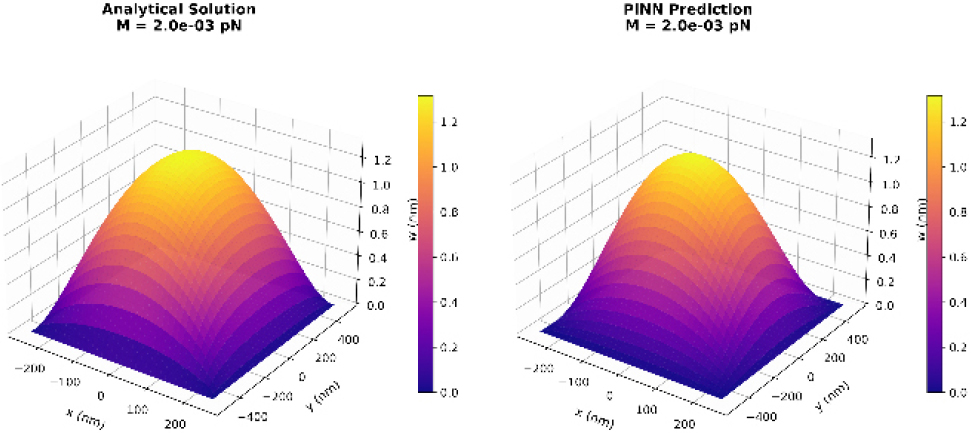
The PINN model was trained using the edge moment value of = 2.0 × 10⁻³pN and then tested at two unseen moment values, = 4.0 × 10⁻³pN and = 6.0 × 10⁻³pN. This evaluation was performed to examine whether the trained model could generalize the moment-induced bending behavior of the rectangular lipid membrane beyond the training condition. The PINN predictions were compared with the analytical solution for the same membrane geometry and boundary conditions.
Fig. 1 shows the comparison between the analytical and PINN-predicted deformation fields for the training case, = 2.0 × 10⁻³pN. Both solutions show a smooth dome-shaped deflection profile, with the maximum displacement occurring at the center of the membrane and gradually decreasing toward the constrained edges. The PINN prediction closely follows the analytical deformation pattern, indicating that the network successfully learned the governing bending response from the physics-based loss formulation.
For the unseen test cases, shown in Figs. 2 and 3, the PINN maintains the same deformation trend and symmetry. As the applied edge moment increases from = 4.0 × 10⁻³ to = 6.0 × 10⁻³pN, the central deflection increases proportionally. This confirms that the model captures the expected linear relationship between applied moment and membrane deflection. The predicted surfaces remain smooth and physically consistent, without artificial oscillations or boundary distortions.
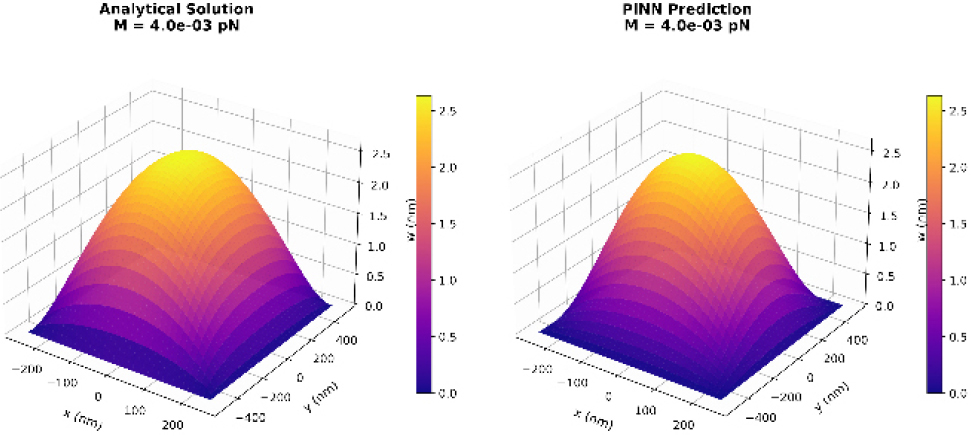
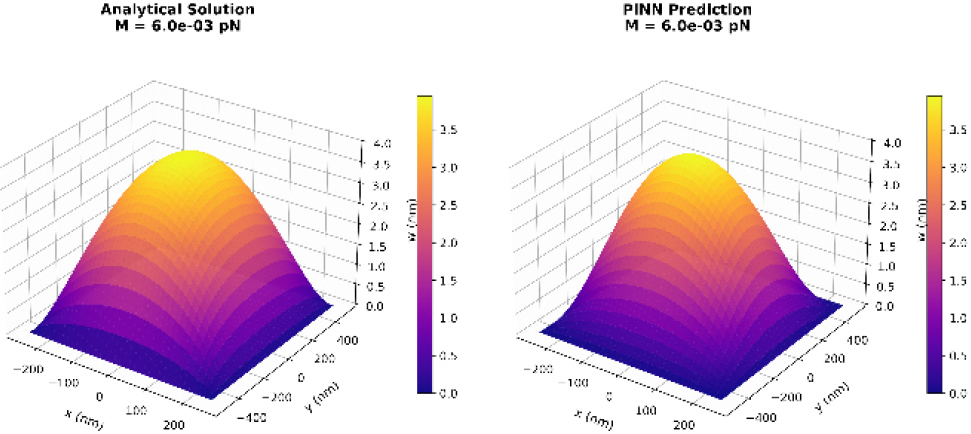
The quantitative comparison is provided in Table 1. For the training case, the analytical center deflection is 1.317022nm, while the PINN predicts 1.314060nm. For the first test case, = 4.0 × 10⁻³ pN, the analytical and PINN center deflections are 2.634044nm and 2.628120nm, respectively. For the second test case, = 6.0 × 10⁻³pN, the analytical value is 3.951066nm, and the PINN prediction is 3.942179nm. These results show excellent agreement between the two solutions.
Table 1.
Comparison between analytical and PINN-predicted membrane deflections under different applied edge moments
Although the root mean square error increases with increasing moment, this increase is mainly associated with the larger deformation magnitude at higher loading levels. The close agreement in central deflection and overall surface shape indicates that the PINN can accurately reproduce the moment-driven bending response of the lipid membrane. Therefore, the trained model demonstrates good interpolation and generalization capability for the considered moment range.
4. Conclusion
This study demonstrated a PINN-based approach for predicting the moment-induced bending response of a rectangular lipid membrane governed by the linearized Helfrich formulation. The model was trained using a single moment value and then tested at two higher moment levels to evaluate its predictive capability. The results showed close agreement between the PINN and analytical solutions in terms of central deflection, deformation profile, and error distribution. The PINN accurately captured the symmetric dome-shaped membrane deformation and reproduced the expected increase in displacement with applied edge moment. These findings confirm that a physics-informed formulation can solve high-order membrane bending problems without requiring labeled displacement data. The proposed approach provides a mesh-free and physically consistent computational tool for lipid membrane mechanics. Future work may extend this framework to more complex boundary conditions, nonuniform loading, and coupled multiphysics membrane deformation problems.