Research Paper

Journal of the Computational Structural Engineering Institute of Korea. 2014. 137-145
https://doi.org/10.7734/COSEIK.2014.27.3.137

ABSTRACT


MAIN

1. Introduction

Atom-based molecular dynamics(MD) simulations are very useful in analyzing nano-scale phenomena which cannot be captured in a continuum sense. However, atomistic simulation tools themselves are not sufficient for many of the interesting and fundamental problems that arise in computational mechanics, since the length and time scales used in the MD simulations are still limited. Many multiscale analysis methods have been developed considering both the MD and the continuum analyses to solve the problems such as dislocation (Tadmor and Ortiz, 1996), crack propagation(Park et al., 2005; Farrell et al., 2007), and strain localization(Kadowaki and Liu, 2007) which cannot be solved with only continuum- based concept. The main issue of multiscale problems is how to connect the atom-level simulations to continuum-level. Bridging scale method(BSM)(Wagner and Liu, 2003) is introduced by deriving dynamic multiscale boundary conditions as a damping force using the generalized Langevin equation(GLE)(Adelman and Doll, 1974, 1976). They used the MD in a localized region of interest and the finite element method in a global region by decoupling the fine and coarse scales through a mass-weighted projection. This boundary condition prevents the wave reflection in the fine scale without any handshake or scale down regions.

Mathematically, design sensitivity analysis(DSA) methods are well developed based on continuum mechanics for structural systems(Choi and Kim, 2004). Since the MD is one of transient dynamic problems, DSA for transient dynamic problems is indispensible for the design of nano- and micro- scale problems. However, a huge amount of compu-tation is usually required for the MD simulations since they are transient dynamic problems. For the DSA of MD systems that have many design varia-bles, the computational cost is very expensive. Therefore, an efficient and accurate analytical DSA method is necessary in the problems that include molecular dynamics analysis. However, the DSA in the multiscale analysis is not straightforward, since the sensitivity relationship between the scales is not well known yet. Even though the relations are known, iterative sensitivity computations might be necessary between the fine and coarse scales depending on the multiscale decomposition method. Therefore, for an efficient DSA in the multiscale problems, it is important to choose the decom-position method that could provide fully decoupled scales in the DSA. In this research, we suggest an analytical DSA method using a BSM to avoid the aforementioned difficulties in the multiscale problems including the MD simulations. The BSM defines the fine scale as the solution whose projection onto the coarse scale basis functions vanishes; this implies the orthogonality between the fine and coarse scales. In addition, the projection operator used in the BSM gives fully decoupled multiscale equations, which enables us to avoid iterative computations between the scales and to perform efficient DSA in the multiscale problems.

2. Review of Bridging Scale Method

The bridging scale method was developed to couple atomistic and continuum scale simulation (Wagner and Liu, 2003). The main idea is to decompose the total displacement https://cdn.apub.kr/journalsite/sites/jcoseik/2014-027-03/01TK062014270305/images/10.7734.27.3.137.F101.png into coarse and fine scales as

https://cdn.apub.kr/journalsite/sites/jcoseik/2014-027-03/01TK062014270305/images/10.7734.27.3.137.F102.png      (1)

The coarse scale displacement is defined as

https://cdn.apub.kr/journalsite/sites/jcoseik/2014-027-03/01TK062014270305/images/10.7734.27.3.137.F103.png      (2)

where https://cdn.apub.kr/journalsite/sites/jcoseik/2014-027-03/01TK062014270305/images/10.7734.27.3.137.F104.png is the shape function of node https://cdn.apub.kr/journalsite/sites/jcoseik/2014-027-03/01TK062014270305/images/10.7734.27.3.137.F105.png at point https://cdn.apub.kr/journalsite/sites/jcoseik/2014-027-03/01TK062014270305/images/10.7734.27.3.137.F106.png, and https://cdn.apub.kr/journalsite/sites/jcoseik/2014-027-03/01TK062014270305/images/10.7734.27.3.137.F107.png is the FE nodal displacement corresponding to node https://cdn.apub.kr/journalsite/sites/jcoseik/2014-027-03/01TK062014270305/images/10.7734.27.3.137.F108.png. In MD simulation, MD displacement https://cdn.apub.kr/journalsite/sites/jcoseik/2014-027-03/01TK062014270305/images/10.7734.27.3.137.F109.png is regarded as the exact solution. The fine scale displacement is simply that part of the total displacement that the coarse scale cannot represent, and then the error is defined as
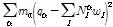
https://cdn.apub.kr/journalsite/sites/jcoseik/2014-027-03/01TK062014270305/images/10.7734.27.3.137.F110.png      (3)

which means mass-weighted square of the fine scale, and a temporary nodal solution https://cdn.apub.kr/journalsite/sites/jcoseik/2014-027-03/01TK062014270305/images/10.7734.27.3.137.F111.png is determined to minimize the error, which yields

https://cdn.apub.kr/journalsite/sites/jcoseik/2014-027-03/01TK062014270305/images/10.7734.27.3.137.F112.png      (4)

where https://cdn.apub.kr/journalsite/sites/jcoseik/2014-027-03/01TK062014270305/images/10.7734.27.3.137.F113.png is a diagonal atomic mass matrix, and https://cdn.apub.kr/journalsite/sites/jcoseik/2014-027-03/01TK062014270305/images/10.7734.27.3.137.F114.png. Then, the fine scale displacement https://cdn.apub.kr/journalsite/sites/jcoseik/2014-027-03/01TK062014270305/images/10.7734.27.3.137.F115.png is written as

https://cdn.apub.kr/journalsite/sites/jcoseik/2014-027-03/01TK062014270305/images/10.7734.27.3.137.F116.png      (5)

where the projection matrix P is defined as

https://cdn.apub.kr/journalsite/sites/jcoseik/2014-027-03/01TK062014270305/images/10.7734.27.3.137.F118.png      (6)

Finally, the total displacement is rewritten as

https://cdn.apub.kr/journalsite/sites/jcoseik/2014-027-03/01TK062014270305/images/10.7734.27.3.137.F119.png      (7)

where the complimentary projector https://cdn.apub.kr/journalsite/sites/jcoseik/2014-027-03/01TK062014270305/images/10.7734.27.3.137.F120.png.

3. Generalized Langevin Equation

A free vibration equation is generally written as

https://cdn.apub.kr/journalsite/sites/jcoseik/2014-027-03/01TK062014270305/images/10.7734.27.3.137.F121.png      (8)

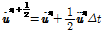
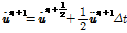
https://cdn.apub.kr/journalsite/sites/jcoseik/2014-027-03/01TK062014270305/images/10.7734.27.3.137.F122.png is a displacement field at time https://cdn.apub.kr/journalsite/sites/jcoseik/2014-027-03/01TK062014270305/images/10.7734.27.3.137.F123.png, https://cdn.apub.kr/journalsite/sites/jcoseik/2014-027-03/01TK062014270305/images/10.7734.27.3.137.F124.png is a mass matrix, and https://cdn.apub.kr/journalsite/sites/jcoseik/2014-027-03/01TK062014270305/images/10.7734.27.3.137.F125.png is a stiffness matrices. Then we can solve Eq. (8) using the velocity verlet algorithm,
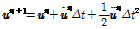
https://cdn.apub.kr/journalsite/sites/jcoseik/2014-027-03/01TK062014270305/images/10.7734.27.3.137.F126.png      (9a)

https://cdn.apub.kr/journalsite/sites/jcoseik/2014-027-03/01TK062014270305/images/10.7734.27.3.137.F127.png      (9b)

https://cdn.apub.kr/journalsite/sites/jcoseik/2014-027-03/01TK062014270305/images/10.7734.27.3.137.F128.png      (9c)

https://cdn.apub.kr/journalsite/sites/jcoseik/2014-027-03/01TK062014270305/images/10.7734.27.3.137.F129.png      (9d)

Consider an one-dimensional atomic chain shown in Fig. 1. (a) and (b) show a full MD system and a reduced one, respectively.

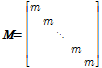
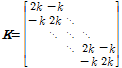
For simplicity, https://cdn.apub.kr/journalsite/sites/jcoseik/2014-027-03/01TK062014270305/images/10.7734.27.3.137.F132.png and https://cdn.apub.kr/journalsite/sites/jcoseik/2014-027-03/01TK062014270305/images/10.7734.27.3.137.F133.png are given as

https://cdn.apub.kr/journalsite/sites/jcoseik/2014-027-03/01TK062014270305/images/10.7734.27.3.137.F134.png, https://cdn.apub.kr/journalsite/sites/jcoseik/2014-027-03/01TK062014270305/images/10.7734.27.3.137.F135.png      (10)

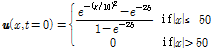
where https://cdn.apub.kr/journalsite/sites/jcoseik/2014-027-03/01TK062014270305/images/10.7734.27.3.137.F136.png1, and the initial condition is given as Gaussian type distribution as

https://cdn.apub.kr/journalsite/sites/jcoseik/2014-027-03/01TK062014270305/images/10.7734.27.3.137.F130.pnghttps://cdn.apub.kr/journalsite/sites/jcoseik/2014-027-03/01TK062014270305/images/10.7734.27.3.137.F131.png
Figure 1

One-dimensional atomic chain

https://cdn.apub.kr/journalsite/sites/jcoseik/2014-027-03/01TK062014270305/images/10.7734.27.3.137.F137.png      (11)

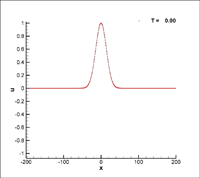
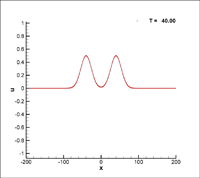
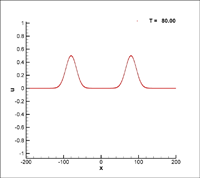
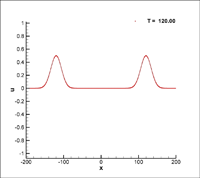
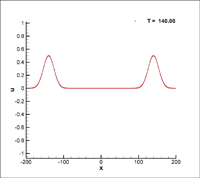
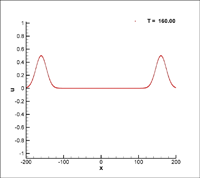
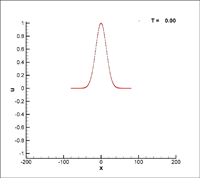
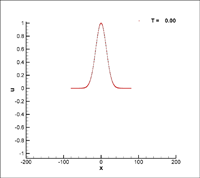
Simulation results for the full MD system are plotted in Fig. 2. It is observed that the initial wave propagates smoothly in both directions.

Assume that displacement https://cdn.apub.kr/journalsite/sites/jcoseik/2014-027-03/01TK062014270305/images/10.7734.27.3.137.F150.png is partitioned into two parts, i.e. https://cdn.apub.kr/journalsite/sites/jcoseik/2014-027-03/01TK062014270305/images/10.7734.27.3.137.F151.png is the solution of interest, whose degrees of freedom will be kept, and https://cdn.apub.kr/journalsite/sites/jcoseik/2014-027-03/01TK062014270305/images/10.7734.27.3.137.F152.png is the solution to be mathematically replaced by boundary forces. In this example, the interface between https://cdn.apub.kr/journalsite/sites/jcoseik/2014-027-03/01TK062014270305/images/10.7734.27.3.137.F151.png and https://cdn.apub.kr/journalsite/sites/jcoseik/2014-027-03/01TK062014270305/images/10.7734.27.3.137.F152.png lies at https://cdn.apub.kr/journalsite/sites/jcoseik/2014-027-03/01TK062014270305/images/10.7734.27.3.137.F155.png80. Then Eq. (8) is decomposed into those two parts as
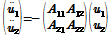
https://cdn.apub.kr/journalsite/sites/jcoseik/2014-027-03/01TK062014270305/images/10.7734.27.3.137.F156.png      (12)

https://cdn.apub.kr/journalsite/sites/jcoseik/2014-027-03/01TK062014270305/images/10.7734.27.3.137.F138.pnghttps://cdn.apub.kr/journalsite/sites/jcoseik/2014-027-03/01TK062014270305/images/10.7734.27.3.137.F139.pnghttps://cdn.apub.kr/journalsite/sites/jcoseik/2014-027-03/01TK062014270305/images/10.7734.27.3.137.F142.pnghttps://cdn.apub.kr/journalsite/sites/jcoseik/2014-027-03/01TK062014270305/images/10.7734.27.3.137.F143.pnghttps://cdn.apub.kr/journalsite/sites/jcoseik/2014-027-03/01TK062014270305/images/10.7734.27.3.137.F146.pnghttps://cdn.apub.kr/journalsite/sites/jcoseik/2014-027-03/01TK062014270305/images/10.7734.27.3.137.F147.png
Figure 2

Wave propagation in Full MD system

https://cdn.apub.kr/journalsite/sites/jcoseik/2014-027-03/01TK062014270305/images/10.7734.27.3.137.F161.pnghttps://cdn.apub.kr/journalsite/sites/jcoseik/2014-027-03/01TK062014270305/images/10.7734.27.3.137.F162.pnghttps://cdn.apub.kr/journalsite/sites/jcoseik/2014-027-03/01TK062014270305/images/10.7734.27.3.137.F165.pnghttps://cdn.apub.kr/journalsite/sites/jcoseik/2014-027-03/01TK062014270305/images/10.7734.27.3.137.F166.pnghttps://cdn.apub.kr/journalsite/sites/jcoseik/2014-027-03/01TK062014270305/images/10.7734.27.3.137.F169.pnghttps://cdn.apub.kr/journalsite/sites/jcoseik/2014-027-03/01TK062014270305/images/10.7734.27.3.137.F170.png
Figure 3

Wave reflection in Reduced system

where https://cdn.apub.kr/journalsite/sites/jcoseik/2014-027-03/01TK062014270305/images/10.7734.27.3.137.F157.png. If we merely regard https://cdn.apub.kr/journalsite/sites/jcoseik/2014-027-03/01TK062014270305/images/10.7734.27.3.137.F152.png as zero, then we have

https://cdn.apub.kr/journalsite/sites/jcoseik/2014-027-03/01TK062014270305/images/10.7734.27.3.137.F159.png      (13)

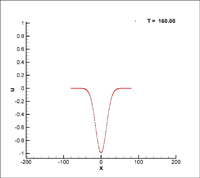
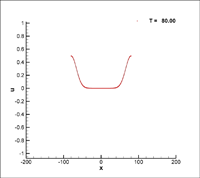
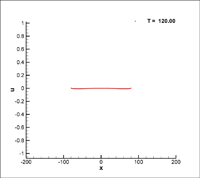
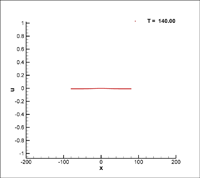
When a reduced system is introduced only between https://cdn.apub.kr/journalsite/sites/jcoseik/2014-027-03/01TK062014270305/images/10.7734.27.3.137.F160.png=±80 without GLE force, this approach causes an unwanted boundary wave reflection as Fig. 3.

At time https://cdn.apub.kr/journalsite/sites/jcoseik/2014-027-03/01TK062014270305/images/10.7734.27.3.137.F173.png160, the same wave as the initial condition is reflecting with reverse phase. Instead, we introduce generalized Langevin equation to remove boundary reflection. First of all, the degrees of freedom https://cdn.apub.kr/journalsite/sites/jcoseik/2014-027-03/01TK062014270305/images/10.7734.27.3.137.F152.png are eliminated by solving Eq. (12) and substituting the result back into the equation for https://cdn.apub.kr/journalsite/sites/jcoseik/2014-027-03/01TK062014270305/images/10.7734.27.3.137.F151.png.

https://cdn.apub.kr/journalsite/sites/jcoseik/2014-027-03/01TK062014270305/images/10.7734.27.3.137.F176.png      (14)

To obtain https://cdn.apub.kr/journalsite/sites/jcoseik/2014-027-03/01TK062014270305/images/10.7734.27.3.137.F177.png explicitly, the Laplace transform is introduced. The Laplace transform of a function https://cdn.apub.kr/journalsite/sites/jcoseik/2014-027-03/01TK062014270305/images/10.7734.27.3.137.F178.png, defined for all real numbers https://cdn.apub.kr/journalsite/sites/jcoseik/2014-027-03/01TK062014270305/images/10.7734.27.3.137.F179.png0, is the function https://cdn.apub.kr/journalsite/sites/jcoseik/2014-027-03/01TK062014270305/images/10.7734.27.3.137.F180.png defined by

https://cdn.apub.kr/journalsite/sites/jcoseik/2014-027-03/01TK062014270305/images/10.7734.27.3.137.F181.png      (15)

where the Laplace operator https://cdn.apub.kr/journalsite/sites/jcoseik/2014-027-03/01TK062014270305/images/10.7734.27.3.137.F182.png transforms time domain https://cdn.apub.kr/journalsite/sites/jcoseik/2014-027-03/01TK062014270305/images/10.7734.27.3.137.F183.png into space domain https://cdn.apub.kr/journalsite/sites/jcoseik/2014-027-03/01TK062014270305/images/10.7734.27.3.137.F184.png. The inverse Laplace transform is given by the following complex integral

https://cdn.apub.kr/journalsite/sites/jcoseik/2014-027-03/01TK062014270305/images/10.7734.27.3.137.F185.png      (16)

where https://cdn.apub.kr/journalsite/sites/jcoseik/2014-027-03/01TK062014270305/images/10.7734.27.3.137.F186.png is a real number so that the contour path of integration is in the region of convergence of https://cdn.apub.kr/journalsite/sites/jcoseik/2014-027-03/01TK062014270305/images/10.7734.27.3.137.F187.png normally requiring https://cdn.apub.kr/journalsite/sites/jcoseik/2014-027-03/01TK062014270305/images/10.7734.27.3.137.F188.png for every singularity https://cdn.apub.kr/journalsite/sites/jcoseik/2014-027-03/01TK062014270305/images/10.7734.27.3.137.F189.png of https://cdn.apub.kr/journalsite/sites/jcoseik/2014-027-03/01TK062014270305/images/10.7734.27.3.137.F190.png. Using the definition of the Laplace transformation as Eq. (15), the following properties can be derived:
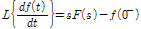
https://cdn.apub.kr/journalsite/sites/jcoseik/2014-027-03/01TK062014270305/images/10.7734.27.3.137.F191.png      (17a)

https://cdn.apub.kr/journalsite/sites/jcoseik/2014-027-03/01TK062014270305/images/10.7734.27.3.137.F192.png      (17b)

and another useful property of the Laplace transform is the convolution property as

https://cdn.apub.kr/journalsite/sites/jcoseik/2014-027-03/01TK062014270305/images/10.7734.27.3.137.F193.png      (18)

Applying Eq. (17b) into Eq. (14) gives

https://cdn.apub.kr/journalsite/sites/jcoseik/2014-027-03/01TK062014270305/images/10.7734.27.3.137.F194.png      (19)

Rearranging Eq. (19) yields

https://cdn.apub.kr/journalsite/sites/jcoseik/2014-027-03/01TK062014270305/images/10.7734.27.3.137.F195.png      (20)

where the matrix https://cdn.apub.kr/journalsite/sites/jcoseik/2014-027-03/01TK062014270305/images/10.7734.27.3.137.F196.png can be written as

https://cdn.apub.kr/journalsite/sites/jcoseik/2014-027-03/01TK062014270305/images/10.7734.27.3.137.F197.png      (21)

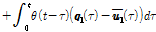
Taking the inverse Laplace transform on Eq. (20) and using the convolution rule, the equation for https://cdn.apub.kr/journalsite/sites/jcoseik/2014-027-03/01TK062014270305/images/10.7734.27.3.137.F198.png is derived as

https://cdn.apub.kr/journalsite/sites/jcoseik/2014-027-03/01TK062014270305/images/10.7734.27.3.137.F199.png      (22)

where the time history kernel https://cdn.apub.kr/journalsite/sites/jcoseik/2014-027-03/01TK062014270305/images/10.7734.27.3.137.F200.png is

https://cdn.apub.kr/journalsite/sites/jcoseik/2014-027-03/01TK062014270305/images/10.7734.27.3.137.F201.png      (23)

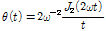
For given mass and stiffness matrices https://cdn.apub.kr/journalsite/sites/jcoseik/2014-027-03/01TK062014270305/images/10.7734.27.3.137.F124.png and https://cdn.apub.kr/journalsite/sites/jcoseik/2014-027-03/01TK062014270305/images/10.7734.27.3.137.F125.png, https://cdn.apub.kr/journalsite/sites/jcoseik/2014-027-03/01TK062014270305/images/10.7734.27.3.137.F200.png is derived analytically(Wagner and Liu, 2003)
https://cdn.apub.kr/journalsite/sites/jcoseik/2014-027-03/01TK062014270305/images/10.7734.27.3.137.F205.png      (24)

where https://cdn.apub.kr/journalsite/sites/jcoseik/2014-027-03/01TK062014270305/images/10.7734.27.3.137.F206.png is a first-kind second-order Bessel function, and https://cdn.apub.kr/journalsite/sites/jcoseik/2014-027-03/01TK062014270305/images/10.7734.27.3.137.F207.png. Substituting Eq. (22) into Eq. (12) yields the equation for https://cdn.apub.kr/journalsite/sites/jcoseik/2014-027-03/01TK062014270305/images/10.7734.27.3.137.F208.png

https://cdn.apub.kr/journalsite/sites/jcoseik/2014-027-03/01TK062014270305/images/10.7734.27.3.137.F209.png      (25)

https://cdn.apub.kr/journalsite/sites/jcoseik/2014-027-03/01TK062014270305/images/10.7734.27.3.137.F210.png

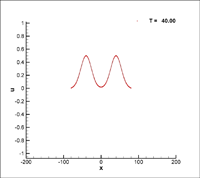
The second to fourth terms in Eq. (25) are the GLE forces and prevent boundary reflections. As shown in Fig. 4, the initial wave passes smoothly through the boundary and no reflection happens.
https://cdn.apub.kr/journalsite/sites/jcoseik/2014-027-03/01TK062014270305/images/10.7734.27.3.137.F211.pnghttps://cdn.apub.kr/journalsite/sites/jcoseik/2014-027-03/01TK062014270305/images/10.7734.27.3.137.F212.pnghttps://cdn.apub.kr/journalsite/sites/jcoseik/2014-027-03/01TK062014270305/images/10.7734.27.3.137.F215.pnghttps://cdn.apub.kr/journalsite/sites/jcoseik/2014-027-03/01TK062014270305/images/10.7734.27.3.137.F216.pnghttps://cdn.apub.kr/journalsite/sites/jcoseik/2014-027-03/01TK062014270305/images/10.7734.27.3.137.F219.pnghttps://cdn.apub.kr/journalsite/sites/jcoseik/2014-027-03/01TK062014270305/images/10.7734.27.3.137.F220.png
Figure 4

Reduced system with GLE force

https://cdn.apub.kr/journalsite/sites/jcoseik/2014-027-03/01TK062014270305/images/10.7734.27.3.137.F223.pnghttps://cdn.apub.kr/journalsite/sites/jcoseik/2014-027-03/01TK062014270305/images/10.7734.27.3.137.F224.png
Figure 5

One-dimensional MD-continuum chain

Then, the generalized Langevin equation(GLE) is utilized to simulate a coupled MD-continuum equation. The bridging scale method is applicable to the problems where the MD region is confined to a small portion of the domain, while the continuum region exists in the whole domain. It may be possible to solve the full MD system, but it requires huge amount of computational cost, especially in 2- or 3-dimensional case. The advantage of bridging scale method is that one can precisely solve the specific region of interest using MD simulation, and bridge MD solution with continuum solution at the MD-continuum boundary. Also, the fine scale waves in MD region pass the boundary smoothly into continuum region by GLE force.

Consider one-dimensional MD-continuum coupled simulation(Park and Liu, 2004) as shown in Fig. 5. The entire domain is -200https://cdn.apub.kr/journalsite/sites/jcoseik/2014-027-03/01TK062014270305/images/10.7734.27.3.137.F225.png200, and the MD particles lie at -80https://cdn.apub.kr/journalsite/sites/jcoseik/2014-027-03/01TK062014270305/images/10.7734.27.3.137.F225.png80.

In brief, the coupled MD/FE equations of motion are described as
https://cdn.apub.kr/journalsite/sites/jcoseik/2014-027-03/01TK062014270305/images/10.7734.27.3.137.F231.pnghttps://cdn.apub.kr/journalsite/sites/jcoseik/2014-027-03/01TK062014270305/images/10.7734.27.3.137.F232.pnghttps://cdn.apub.kr/journalsite/sites/jcoseik/2014-027-03/01TK062014270305/images/10.7734.27.3.137.F235.pnghttps://cdn.apub.kr/journalsite/sites/jcoseik/2014-027-03/01TK062014270305/images/10.7734.27.3.137.F236.pnghttps://cdn.apub.kr/journalsite/sites/jcoseik/2014-027-03/01TK062014270305/images/10.7734.27.3.137.F239.pnghttps://cdn.apub.kr/journalsite/sites/jcoseik/2014-027-03/01TK062014270305/images/10.7734.27.3.137.F240.png
Figure 6

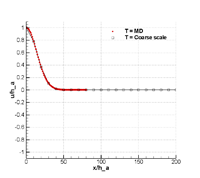
BSM with GLE force at MD-continuum boundary

https://cdn.apub.kr/journalsite/sites/jcoseik/2014-027-03/01TK062014270305/images/10.7734.27.3.137.F227.png      (26)

https://cdn.apub.kr/journalsite/sites/jcoseik/2014-027-03/01TK062014270305/images/10.7734.27.3.137.F228.png

https://cdn.apub.kr/journalsite/sites/jcoseik/2014-027-03/01TK062014270305/images/10.7734.27.3.137.F229.png      (27)

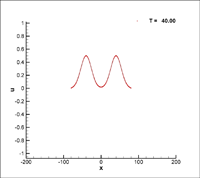
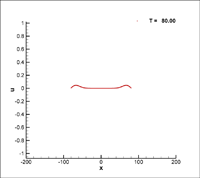
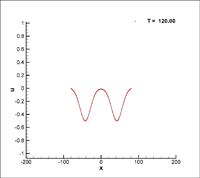
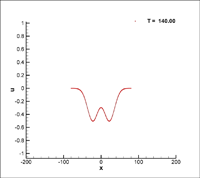
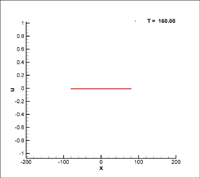
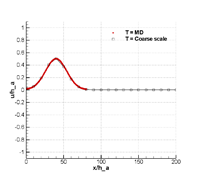
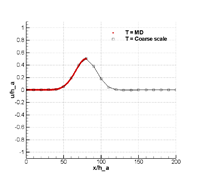
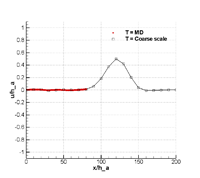
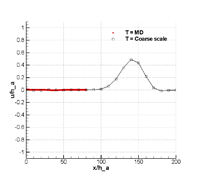
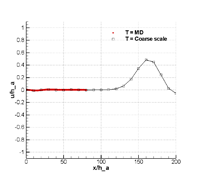
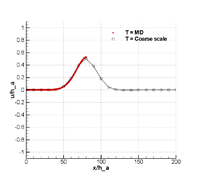
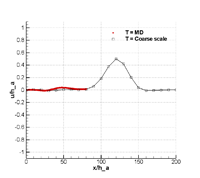
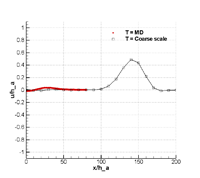
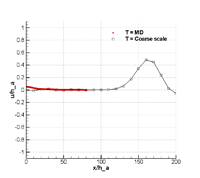
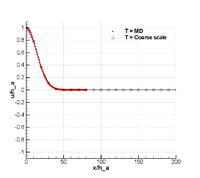
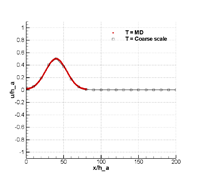
In Fig. 6 and 7, the solid and void dots denote the positions of MD particles and FE nodal points, respectively. From the initial condition, a wave is propagating in both directions. Due to symmetry, the solution at https://cdn.apub.kr/journalsite/sites/jcoseik/2014-027-03/01TK062014270305/images/10.7734.27.3.137.F230.png0 is plotted in all the figures. In Fig. 6, GLE force is applied at MD-continuum boundary and the initial wave passes out of the MD region smoothly without any boundary reflections.
https://cdn.apub.kr/journalsite/sites/jcoseik/2014-027-03/01TK062014270305/images/10.7734.27.3.137.F243.pnghttps://cdn.apub.kr/journalsite/sites/jcoseik/2014-027-03/01TK062014270305/images/10.7734.27.3.137.F244.pnghttps://cdn.apub.kr/journalsite/sites/jcoseik/2014-027-03/01TK062014270305/images/10.7734.27.3.137.F247.pnghttps://cdn.apub.kr/journalsite/sites/jcoseik/2014-027-03/01TK062014270305/images/10.7734.27.3.137.F248.pnghttps://cdn.apub.kr/journalsite/sites/jcoseik/2014-027-03/01TK062014270305/images/10.7734.27.3.137.F251.pnghttps://cdn.apub.kr/journalsite/sites/jcoseik/2014-027-03/01TK062014270305/images/10.7734.27.3.137.F252.png
Figure 7

BSM with boundary velocity approach

However, if the boundary condition is simply applied by setting the MD velocity at the boundary equal to the coarse scale velocity, the fine scale waves cannot pass through the MD-continuum boundary and undesirable wave reflections occur at the boundary as shown in Fig. 7.

4. Design Sensitivity Analysis

Assume that https://cdn.apub.kr/journalsite/sites/jcoseik/2014-027-03/01TK062014270305/images/10.7734.27.3.137.F255.png has zero initial condition as

https://cdn.apub.kr/journalsite/sites/jcoseik/2014-027-03/01TK062014270305/images/10.7734.27.3.137.F256.png      (28)

Then, Eq. (25) is rewritten as

https://cdn.apub.kr/journalsite/sites/jcoseik/2014-027-03/01TK062014270305/images/10.7734.27.3.137.F257.png      (29)

4.1 Perturbation of https://cdn.apub.kr/journalsite/sites/jcoseik/2014-027-03/01TK062014270305/images/10.7734.27.3.137.F258.png by 0.1%

The design sensitivity equation for https://cdn.apub.kr/journalsite/sites/jcoseik/2014-027-03/01TK062014270305/images/10.7734.27.3.137.F208.png is obtained from the derivative of Eq. (29) with respect to stiffness k as

https://cdn.apub.kr/journalsite/sites/jcoseik/2014-027-03/01TK062014270305/images/10.7734.27.3.137.F260.png      (30)

https://cdn.apub.kr/journalsite/sites/jcoseik/2014-027-03/01TK062014270305/images/10.7734.27.3.137.F261.png

Using velocity verlet algorithm, the displacement sensitivity https://cdn.apub.kr/journalsite/sites/jcoseik/2014-027-03/01TK062014270305/images/10.7734.27.3.137.F262.png is updated. The derivative https://cdn.apub.kr/journalsite/sites/jcoseik/2014-027-03/01TK062014270305/images/10.7734.27.3.137.F263.png is easily obtainable, and https://cdn.apub.kr/journalsite/sites/jcoseik/2014-027-03/01TK062014270305/images/10.7734.27.3.137.F208.png is already available from the dynamic solution of Eq. (8). The accuracy of design sensitivity of displacement is verified in Table 1. For each time step , the analytic sensitivity is compared with the finite difference sensitivity. In the last column, very good agreement is observed at every time step.

Table 1

Design sensitivity agreement at x=0

Time t  Finite difference sensitivity  Analytical sensitivity  Agreement(%)
50-5.98328E-05-6.00210E-0599.69
1001.55272E-071.53035E-07101.46
1508.59221E-048.56186E-04100.35
2005.61980E-055.61980E-0599.22
2503.72665E-053.72915E-0599.93
3003.36549E-053.36158E-05100.12
3503.45926E-063.43558E-06100.69
4001.70420E-061.69541E-06100.52

4.2 Perturbation of all https://cdn.apub.kr/journalsite/sites/jcoseik/2014-027-03/01TK062014270305/images/10.7734.27.3.137.F268.png by 0.1%

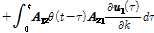
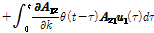
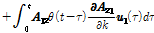
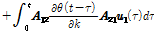
The design sensitivity equation for https://cdn.apub.kr/journalsite/sites/jcoseik/2014-027-03/01TK062014270305/images/10.7734.27.3.137.F208.png is obtained from the derivative of Eq. (29). Unlike Eq. (30), there are more design dependent terms as

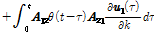
https://cdn.apub.kr/journalsite/sites/jcoseik/2014-027-03/01TK062014270305/images/10.7734.27.3.137.F270.png      (31)

https://cdn.apub.kr/journalsite/sites/jcoseik/2014-027-03/01TK062014270305/images/10.7734.27.3.137.F271.png

https://cdn.apub.kr/journalsite/sites/jcoseik/2014-027-03/01TK062014270305/images/10.7734.27.3.137.F272.png

https://cdn.apub.kr/journalsite/sites/jcoseik/2014-027-03/01TK062014270305/images/10.7734.27.3.137.F273.png

https://cdn.apub.kr/journalsite/sites/jcoseik/2014-027-03/01TK062014270305/images/10.7734.27.3.137.F274.png

Table 2

Design sensitivity agreement at x=0

Time t    Finite difference sensitivity    Analytical sensitivity    Agreement(%)
50-5.98328E-05-6.00210E-0599.69
100-1.13985E-08-1.12662E-08101.17
150-1.38233E-04-1.37916E-04100.23
200-7.19341E-05-7.19751E-0599.94
250-6.47973E-05-6.48062E-0599.99
300-6.08876E-05-6.09023E-0599.98
350-5.08988E-05-5.09237E-0599.95
400-4.41505E-05-4.41762E-0599.94

The derivatives https://cdn.apub.kr/journalsite/sites/jcoseik/2014-027-03/01TK062014270305/images/10.7734.27.3.137.F275.png, https://cdn.apub.kr/journalsite/sites/jcoseik/2014-027-03/01TK062014270305/images/10.7734.27.3.137.F276.pngand https://cdn.apub.kr/journalsite/sites/jcoseik/2014-027-03/01TK062014270305/images/10.7734.27.3.137.F277.png are easily obtainable, and https://cdn.apub.kr/journalsite/sites/jcoseik/2014-027-03/01TK062014270305/images/10.7734.27.3.137.F208.png is already available from the dynamic solution of Eq. (8). Using the relation
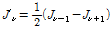
https://cdn.apub.kr/journalsite/sites/jcoseik/2014-027-03/01TK062014270305/images/10.7734.27.3.137.F279.png      (32)

the derivative of time history kernel is derived as
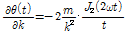
https://cdn.apub.kr/journalsite/sites/jcoseik/2014-027-03/01TK062014270305/images/10.7734.27.3.137.F281.png      (33)

https://cdn.apub.kr/journalsite/sites/jcoseik/2014-027-03/01TK062014270305/images/10.7734.27.3.137.F282.png

https://cdn.apub.kr/journalsite/sites/jcoseik/2014-027-03/01TK062014270305/images/10.7734.27.3.137.F283.png

The accuracy of design sensitivity of displacement is also verified in Table 2. For each time step t, the analytic sensitivity is compared to the finite difference sensitivity. In the last column, good agreement is observed at every time step.

5. Conclusions

A multi-scale DSA method is developed using a bridging scale approach. To avoid any iterative computations between the scales, we use a fully decoupled equation for each scale in original response as well as sensitivity analyses. Through a GLE, a locally confined MD region instead of whole MD system is considered for the fine scale solution whereas a FE analysis for the coarse scale solution is performed on the whole region. The efficiency of the developed method is achieved due to the fully decoupled multi- scale equations in these scales, which are derived using identical mass-weighted projection in the response analysis. Numerical implementations demonstrate the accuracy of the developed DSA method for various design variables. The developed method turns out to work very well for any design variable in both scales.


Acknowledgements

This work was supported by the National Research Foundation of Korea(NRF) grant funded by the Korea government(MSIP)(No. 2010-0018282). The support is gratefully acknowledged. The authors would also like to thank Ms. Inyoung Cho at Korea University for editing assistance.

References

1
Adelman, S.A., Doll, J.D.Generalized Langevin Equation Approach for Atom/Solid- Surface Scattering: Collinear atom/harmonic ChainThe Journal of Chemical Physics6110424242451974full_text10.1063/1.168172310.1063/1.1681723
2
Adelman, S.A., Doll, J.D.Generalized Langevin Equation Approach for Atom/Solid-Surface Scattering: General Formulation for Classical Scattering off Harmonic SolidsThe Journal of Chemical Physics19766462375238810.1063/1.43252610.1063/1.432526
3
Cho, S., Choi, K.K.Design Sensitivity Analysis and Optimization of Non-Linear Transient Dynamics Part I: sizing designInternational Journal for Numerical Methods in Engineering20004835137310.1002/(SICI)1097-0207(20000530)48:3<351::AID-NME878>3.0.CO;2-P10.1002/(SICI)1097-0207(20000530)48:3<351::AID-NME878>3.0.CO;2-P
4
Choi, K.K., Kim, N.H.Structural Sensitivity Analysis and Optimization: Volume 1, Linear Systems &Volume 2Nonlinear Systems and Applications, Springer, New York.2004
5
Farrell, D.E., Park, H.S., Liu, W.K.Implementation Aspects of the Bridging Scale Method and Application to Intersonic Crack PropagationInternational Journal for Numerical Methods in Engineering20077158360510.1002/nme.198110.1002/nme.1981
6
Kadowaki, H., Liu, W.K.Bridging Multi-Scale Method for Localization ProblemsComputer Methods in Applied Mechanics and Engineering200719317331772
7
Kim, M.G., Ha, S.H., Cho, S.Level Set Based Topological Shape Optimization of Hyper- Elastic Nonlinear Structures Using Topological DerivativesJ. Comput. Struct. Eng. Inst. Korea2012256559567
8
Park, H.S. Liu, W.K.An Introduction and Tutorial on Multiple-Scale Analysis in SolidsComputer Methods in Applied Mechanics and Engineering200419317331772
9
Park, H.S., Karpov, E.G., Klein, P.A., Liu, W.K.Three-Dimensional Bridging Scale Analysis of Dynamic FractureJournal of Computational Physics2005207588609
10
Tadmor, E.B., Ortiz, M., Phillips, R.Quasi Continuum Analysis of Defects in SolidsPhilosophical Magazine199673615291563
11
Tang, S., Hou, T.Y.. Liu, W.K.A Mathematical Framework of the Bridging Scale MethodInternational Journal for Numerical Methods in Engineering20066516881713
12
Wagner, G.J., Liu, W.K.Coupling of Atomistic and Continuum Simulations Using a Bridging Scale DecompositionJournal of Computational Physics2003190249274
페이지 상단으로 이동하기