


1. Introduction
2. Methodology
2.1 Smoothed Particle Hydrodynamics (SPH)
2.2 Geometry and Numerical Simulation
3. Results and Discussion
4. Conclusion
1. Introduction
The necessity of protecting orbital infrastructure from hypervelocity debris and the development of advanced ballistic shielding have driven a scientific shift toward understanding material responses under extreme thermodynamic states (Nuttall and Close, 2020). Hypervelocity impacts (HVI), conventionally defined as collisions exceeding 2-3 km/s, generate high-amplitude shock waves that drive pressures and temperatures well beyond the limits associated with classical solid mechanics. Within this regime, the governing state variables can vary by several orders of magnitude, and the dominant deformation mode shifts from strength-controlled plastic flow to a fluid-like hydrodynamic response in which bulk properties such as compression modulus and density govern the system. In aerospace and defense applications, this shift motivates the use of hybrid layered structures, where complementary energy partitioning between the two layers helps reduce the severity of impact damage (He et al., 2022).
Ti-6Al-4V is chosen as a primary constituent of the panel for its high specific strength, corrosion resistance, and stable performance at elevated temperatures. Under HVI loading, the alloy also undergoes several distinctive microstructural transformations. Once the impact velocity reaches the hypervelocity threshold (approximately 2240m/s), Ti-6Al-4V exhibits martensitic transformations, FCC twinning, and subgrain rotational dynamic recrystallization (He et al., 2022; Wu et al., 2023). Due to its high strength-to-weight ratio and better impact resistance upon impact, it was selected as the top layer for the configuration.
Complementing the lightweight properties of titanium, AISI 1045 steel provides the requisite hardness to resist high-kinetic-energy penetration, though it remains susceptible to failure via shear plugging and fragmentation (Choudhary et al., 2020). The interaction between the two metallic phases produces an impedance mismatch that strongly influences shock wave propagation through the panel. Pairing materials of differing densities and sound speeds allows the stacking sequence to be tuned for more effective stress wave distribution across the thickness. Prior work on titanium-based laminates has shown that the rear facesheet typically absorbs a disproportionate share of the impact energy through membrane stretching and global bending, which indicates that the layer arrangement largely controls the ballistic limit of the system (Rahimijonoush and Bayat, 2020).
Accurate modeling of these heterogeneous impacts requires both a thermodynamically consistent equation of state (EOS) and a constitutive model capable of resolving high-rate plastic flow; the Grüneisen EOS is adopted on this basis. The Modified Johnson-Cook (MJC) plasticity and damage model is widely used alongside it to represent the combined effects of high strain rate, strain hardening, and thermal softening on the flow stress of both titanium and steel (Choudhary et al., 2020).
Although the literature on monolithic metallic plates and titanium-aluminum hybrid systems is extensive (Li et al., 2025; Maurya et al., 2026), high-fidelity computational work specifically addressing the hypervelocity impact response of Ti-6Al-4V/AISI 1045 steel layered panels remains limited (Arinci et al., 2025). Most existing studies on layered composites are confined to small-caliber ballistic protection or to low-to-intermediate velocity regimes. The present work addresses this gap through a numerical investigation of the energy absorption and damage mechanisms of a Ti/Steel layered target under HVI. Using the Grüneisen EOS together with the MJC strength model, the analysis quantifies how the impedance mismatch at the hybrid interface affects penetration, cavitation, and rear-face bulging of the steel plate. The findings are intended to support the design of lightweight armor systems for severe impact environments (Rahimijonoush and Bayat, 2020; Rahmani et al., 2020).
2. Methodology
This section describes the details of the smoothed particle hydrodynamics (SPH) and the proposed numerical methodology using ANSYS/LS-Dyna.
2.1 Smoothed Particle Hydrodynamics (SPH)
Smoothed Particle Hydrodynamics (SPH) is a meshless method developed for problems such as fluid flow (Lee et al., 2021) and solid mechanics (Kim et al., 2023), where conventional grid-based schemes often struggle. Unlike Eulerian formulations, which depend on fixed meshes and require costly remeshing as geometries or topologies evolve, SPH is fully Lagrangian, i.e., the domain is discretized into particles, each carrying a mass and the local physical properties at its center. (Haseeb et al., 2022).
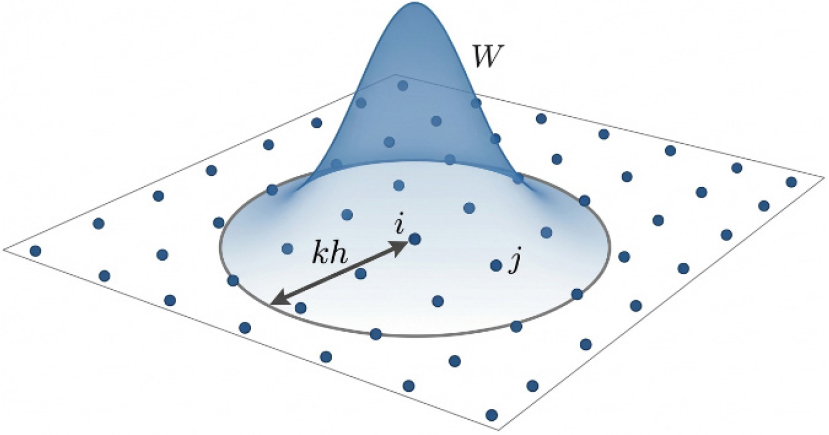
The core of the SPH methodology (Wang et al., 2025) lies in the use of weighted interpolations to determine the state variables of these particles based on their neighbors within a specified domain of influence. As illustrated in the Fig. 1, interaction between a reference particle and its surroundings, the physical properties of a fixed particle are significantly influenced by neighboring particles situated within a radial distance, governed by a smoothing length. This interaction is mathematically formalized through a kernel function (W), which weights the contribution of each neighbor based on its proximity.
The general mathematical expression used to approximate the value of a physical function at a specific particle location is given by the following summation:
In the above fundamental Eq. (1), fi represents the approximated value of the fixed particle, while fj, mj, and ρj denote the approximated value, mass, and density of the neighboring particles, respectively. The spatial coordinates of the fixed and neighboring particles are represented by Xi and Xj, and W(xi − xj, h) signifies the value of the kernel function at that specific location, with h being the smoothing length and the total number of neighboring particles within the influence domain.
2.2 Geometry and Numerical Simulation
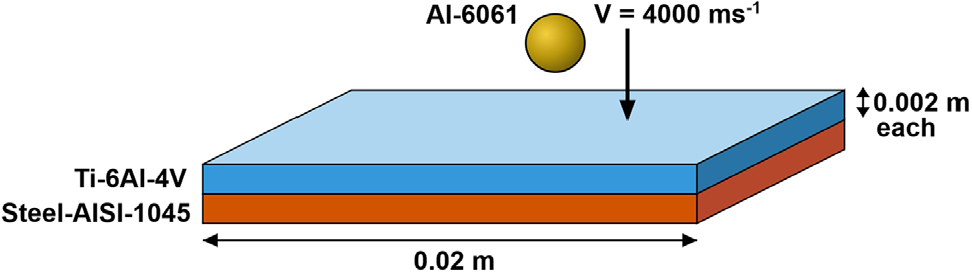
In the present study, the impact problem is configured as follows. An aluminum sphere of radius 0.002 m is selected as the projectile, while the target consists of a layered assembly of plates, each measuring 0.02m × 0.02m × 0.002m. The sphere is assigned an initial velocity of 4000m/s, directed normal to the top surface of the target. A schematic of the complete geometry, along with the corresponding numerical configuration, is presented in Fig. 2. All components of the model, namely the projectile and the target plates, are treated as deformable bodies so that the actual mechanical response of the materials during the impact event can be reproduced.
The simulations are carried out in three dimensions using ANSYS/LS-DYNA. At impact velocities of this order, the target undergoes very large deformation, and a conventional finite element mesh is prone to severe distortion. Such distortion often results in numerical instability and premature termination of the analysis before the impact event is fully captured. To overcome this limitation, the Smoothed Particle Hydrodynamics (SPH) method is adopted in place of the standard mesh-based formulation. The geometry of the sphere as well as the target plates is therefore discretized using particles rather than finite elements, which allows the material to deform, fragment, and flow during penetration without the numerical difficulties associated with mesh distortion.
The numerical simulation framework employs the Modified Johnson-Cook (MJC) (Luo et al., 2025) constitutive model to represent the flow stress of the metallic constituents under the coupled effects of large plastic strains, high strain rates, and adiabatic heating. As a phenomenological development over the original Johnson-Cook law, this model accounts for the material’s hardening behavior, rate sensitivity, and thermal softening, which are critical for predicting target responses during high-velocity and hypervelocity perforation events (Choudhary et al., 2020). The implementation of the MJC model is essential in this regime because it effectively captures the transition from solid-phase strength-dominated deformation to the complex plastic rheology and microstructural transformations observed at higher impact speeds. For the Ti-6Al-4V alloy, the MJC parameters were calibrated through a hybrid experimental-numerical approach using data from split Hopkinson pressure bar tests and quasi-static tensile experiments across diverse stress states to ensure accuracy in predicting localized phenomena such as adiabatic shear banding and plug formation (Wu et al., 2023).
The mechanical behavior of the AISI 1045 steel phase is defined using optimized constitutive parameters derived from isothermal tensile tests and nonlinear programming solvers designed to minimize prediction errors across a practical range of deformation temperatures and strain rates (Murugesan and Jung, 2019). To capture the hydrodynamic response, the Grüneisen equation of state is integrated into the solver to define the relationship between pressure, specific volume, and internal energy. This equation of state is particularly effective for simulating the fluid-like behavior of metals when impact-induced stresses significantly exceed the static yield strength. The comprehensive set of material properties and model constants utilized for both the titanium alloy and the carbon steel in this computational study was extracted directly from the experimental characterizations and optimized models reported in these two primary sources.
3. Results and Discussion
The simulations reveal a tightly coupled set of damage mechanisms emerging within microseconds of contact. As the aluminum sphere strikes the upper Ti-6Al-4V layer, kinetic energy is concentrated over a small area, the local material transitions almost instantly into fully plastic flow, and the projectile disintegrates into a cloud of fragments. Cavitation, here referring to the condition in which the impactor’s lateral diameter becomes smaller than that of the channel it has carved, develops in all three configurations, although its morphology, along with the associated spalling and bulging, varies appreciably with the angle of impact.
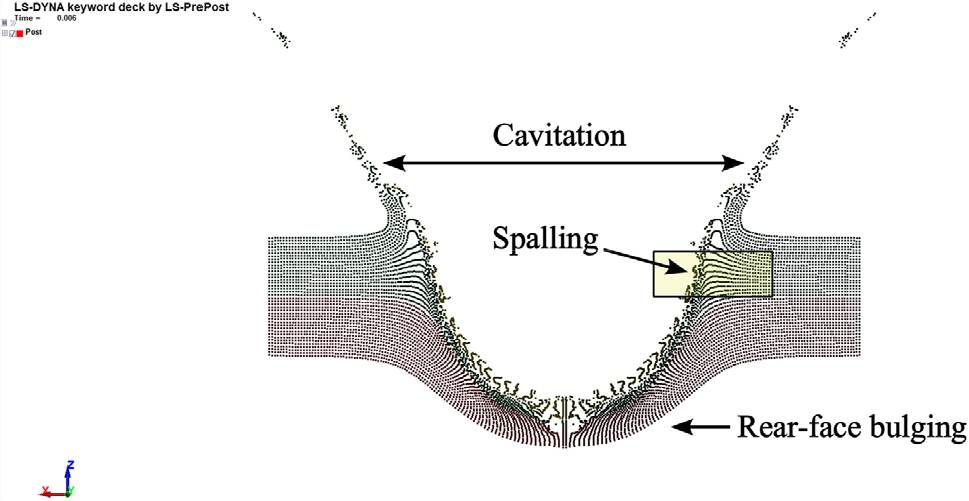
The normal-incidence case serves as the reference configuration. Fig. 3 shows the panel at the end of the simulation, where the three principal damage features are clearly visible: cavitation across the upper Ti-6Al-4V layer, spalling along the Ti-6Al-4V/AISI 1045 interface, and a smooth, axisymmetric bulge on the rear face of the AISI 1045 plate. Spalling concentrates near the interface, where intense dynamic tensile stresses exceed the dynamic spall strength of Ti-6Al-4V. The alignment of the spall band with the boundary suggests that the acoustic impedance mismatch between the two metals controls the spall location. This configuration produces the most pronounced rear-face bulge among the three angles, consistent with its fully through-thickness loading direction.
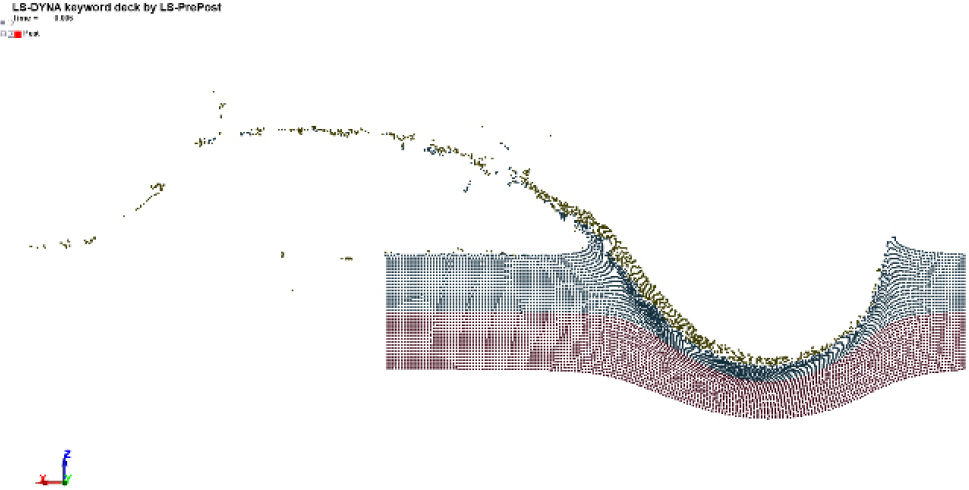
At 45°, the response becomes distinctly asymmetric (Fig. 4). The projectile is almost fully fragmented, the cavity is elongated along the obliquity direction, and an extended debris cloud forms opposite to the obliquity vector, indicating that a measurable fraction of the kinetic energy has been redirected sideways. Cavitation is wider in-plane than through the thickness, and the spall band shifts opposite to the in-plane velocity component at moderate intensity. The rear-face bulge is reduced in amplitude and offset from the impact axis along the in-plane velocity direction, producing off-axis loading effects that a centered load model would not capture.
The 15° grazing case (Fig. 5) represents a near-tangential interaction. The projectile detaches after a brief, glancing contact, leaving a shallow groove and a thin band of plastically deformed material in the upper layer. Neither cavitation nor interfacial spalling develops, since the momentum is directed primarily along the surface and the through-thickness tensile stresses remain well below the spall threshold. The lower AISI 1045 plate shows no visible bulge, and its deformation field remains essentially elastic, i.e., the rear plate is shielded by the geometry of the impact itself rather than by the structural capacity of the panel.
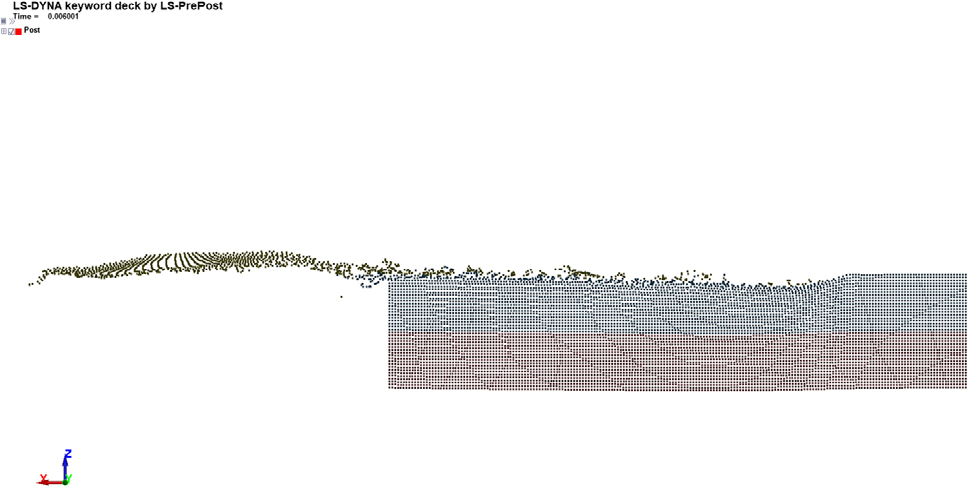
The three configurations represent qualitatively distinct regimes, which are a worst-case full-penetration scenario at 90° in which all damage features are simultaneously active, a 45° transition regime in which lateral momentum partitioning reduces and biases the damage field, and a 15° grazing regime governed almost entirely by surface interaction. Together, they identify impact obliquity as a key parameter controlling the rear-face response of Ti-6Al-4V/AISI 1045 layered shielding under hypersonic spherical impact.
4. Conclusion
The dynamic response of a Ti-6Al-4V/AISI 1045 layered panel under hypersonic spherical impact has been examined through SPH simulations in LS-DYNA at three impact angles, 90°, 45°, and 15°, chosen to span qualitatively distinct loading regimes. Normal incidence produces the most severe response, with simultaneous cavitation in the upper Ti-6Al-4V layer, interfacial spalling along the Ti-6Al-4V/AISI 1045 boundary, and a pronounced, axisymmetric rear-face bulge. At 45°, the response becomes distinctly asymmetric, the cavity elongates, the debris cloud is redirected, and both the spall band and the bulge shift along the in-plane velocity direction, creating off-axis loading that a symmetric model would miss. At 15°, the projectile interacts almost entirely through surface effects, and the lower plate remains essentially undamaged. Together, the three cases identify impact obliquity as the primary parameter governing penetration, damage symmetry, and rear-face response in layered metallic shielding, providing useful guidance for the design of multi-layer Ti-6Al-4V/AISI 1045 panels exposed to both near-normal and oblique high-velocity impacts.